
Climate change is no longer a distant threat — it is already reshaping how buildings behave.
Across the UK, Europe and the United States, heavier rainfall, flash floods, sudden temperature shifts and prolonged damp periods are becoming the norm.
As a result, traditional waterproofing methods are often no longer enough.
This guide explains how modern waterproofing solutions help protect homes and workspaces against climate-driven water damage — and what to look for when choosing the right system in 2026.
Extreme weather patterns now place constant stress on building envelopes:
Prolonged heavy rain saturating roofs and façades
Flash flooding overwhelming drainage systems
Freeze–thaw cycles opening micro-cracks
Higher humidity causing hidden condensation damage
In many cases, water ingress starts not with visible cracks, but with microscopic weaknesses that grow over time.
Older waterproofing systems were designed for predictable climates.
Today’s conditions expose their limitations:
Bitumen-based products becoming brittle
Rigid coatings cracking with thermal movement
Sealants shrinking or losing adhesion
UV exposure accelerating surface degradation
Modern buildings need flexible, elastic and chemically stable waterproofing solutions.
When choosing a waterproofing solution for climate change conditions, look for:
High elasticity to absorb structural movement
Strong adhesion on damp or variable surfaces
UV resistance for long-term outdoor exposure
Seamless application to avoid weak points
Compatibility with different substrates (concrete, metal, PVC, wood)
These features allow waterproofing systems to adapt rather than fail.
Spray membranes are increasingly used for emergency repairs and preventative maintenance. They form a continuous waterproof layer and are particularly effective around joints, penetrations and irregular surfaces.
Solutions such as spray-applied elastomeric membranes are now widely adopted for pipes, window details and roof penetrations.
MS polymer waterproofing membranes offer a solvent-free, flexible barrier that bonds strongly without becoming brittle.
They are commonly used on:
Flat roofs
Balconies and terraces
Parapets and detail zones
Their ability to remain elastic over time makes them well suited to unpredictable weather conditions.
Where surfaces face intense sunlight alongside heavy rain, UV-resistant polyurethane liquid membranes provide durable protection without chalking or cracking.
These systems are frequently selected for:
Terraces
Verandas
Exposed balconies
In environments requiring rapid curing and maximum durability, polyurea coatings are increasingly preferred.
They offer:
Very fast curing times
High mechanical strength
Excellent water and chemical resistance
Depending on the project, both hand-applied and machine-sprayed polyurea systems can be used.
Rather than relying on a single product, climate-resilient waterproofing often combines:
Localised crack and joint sealing
Flexible membranes for large surfaces
Reinforced systems in high-risk zones
This layered approach significantly reduces the risk of future water ingress.
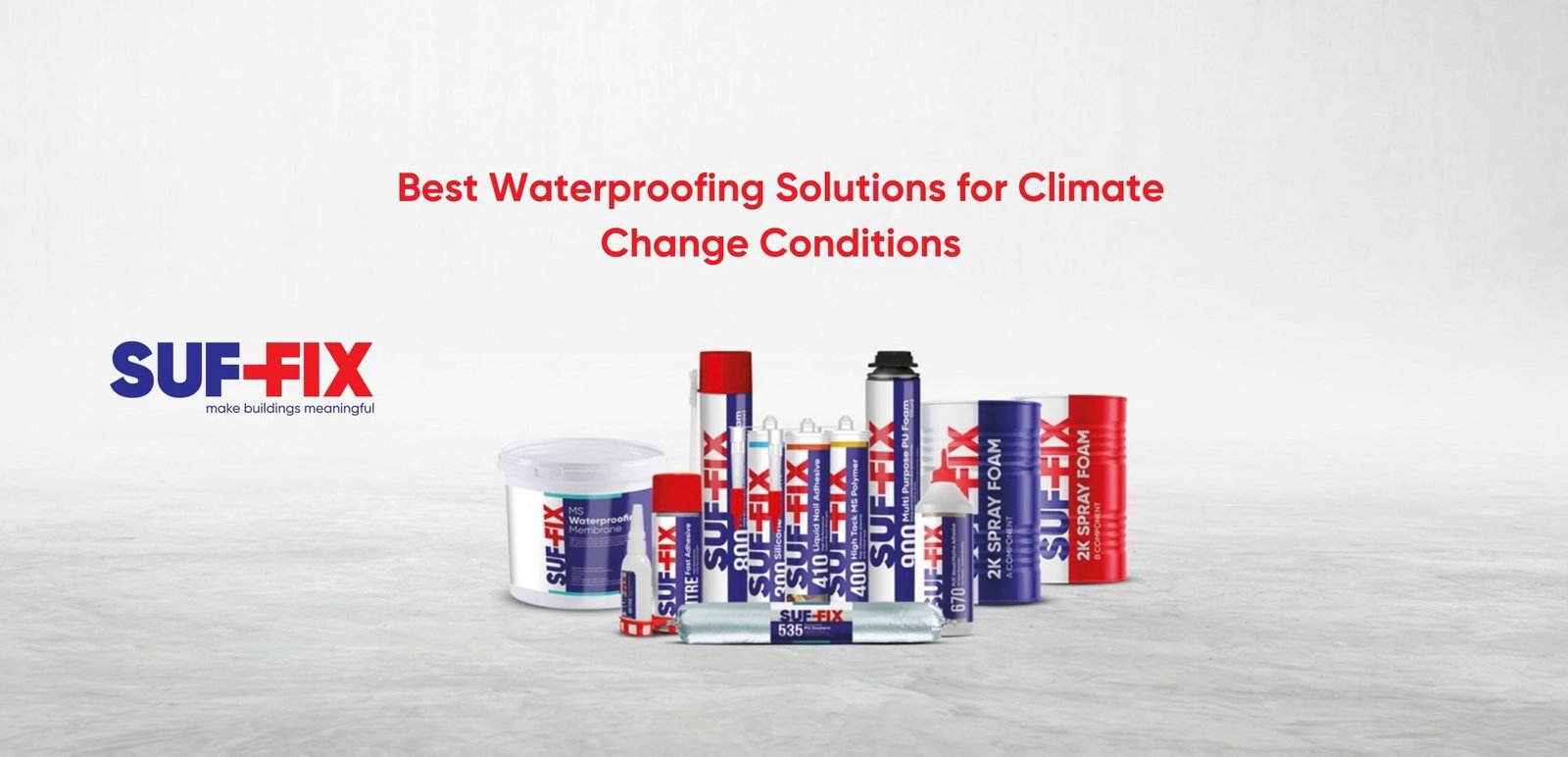
Manufacturers such as Suf-Fix, known for advanced construction chemical solutions, have expanded their waterproofing ranges to address exactly these modern challenges — offering systems designed for real-world climate stress rather than ideal conditions.
As climate change accelerates, waterproofing is no longer just about stopping leaks — it’s about future-proofing buildings.
Choosing flexible, high-performance waterproofing systems today can prevent costly repairs tomorrow and extend the life of structures well into the future.
If you’d like technical advice on selecting the right waterproofing solution for climate-driven conditions, the Suf-Fix technical team is always happy to help:
www.suf-fix.com
Our experts are ready to help you find The right solution for your project.